The Complete History and Culture of Naming Your Jeep: From WWII Willys MBs to Modern Trail Names
Somewhere between 1941 and today, naming a Jeep stopped being a quirky habit a few soldiers picked up and became one of the most consistent, most recognizable traditions in all of car culture. No other vehicle brand has anything close to it — no wide-spread expectation that owners will name their car, no community rituals built around the naming itself, and certainly no separate, deeper tradition (the trail name) layered on top of the vehicle-naming custom. To understand why Jeep culture works this way, you have to go back to where it started: a muddy field, a paintbrush, and a war.
The Willys MB and the Birth of a Habit
The vehicle that became the Jeep — the Willys MB, and its near-identical cousin, the Ford GPW — entered mass production in 1941 as a light, four-wheel-drive reconnaissance and utility vehicle for the U.S. Army. It was cheap, simple, and built to be worked hard and repaired in the field, which meant it ended up everywhere: North Africa, Italy, the Pacific, Normandy, wherever American forces went.
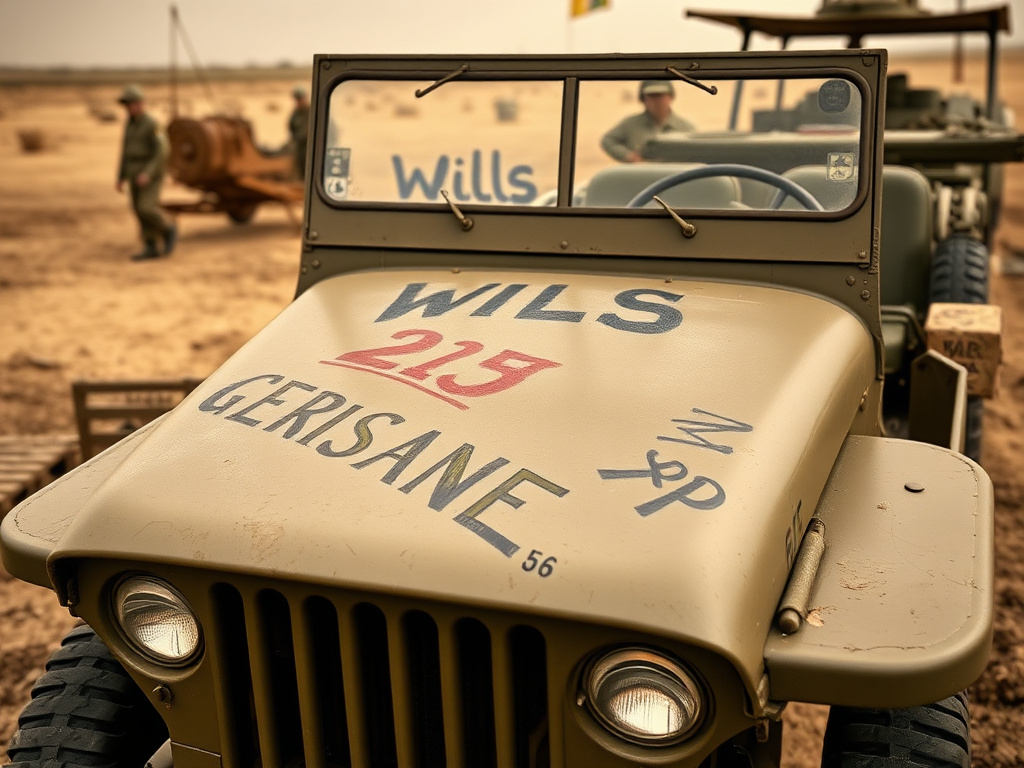
Soldiers who spent months living out of these vehicles did what soldiers have always done with the equipment that keeps them alive: they personalized it. Bomber crews were already famous for elaborate nose art — pin-up girls, cartoon characters, tally marks for missions flown — and painted names to match. Jeep crews picked up the same instinct on a smaller scale. A name scratched into the hood paint with a bayonet tip. A stenciled nickname across the windshield frame. Sometimes just initials and a hometown. It wasn't official Army policy, and it wasn't uniform across units, but it was common enough that it shows up constantly in wartime photography — Jeeps with names like "Sad Sack," "Male Call," or a soldier's girlfriend's name back home, all rendered in the same rough, hand-painted stencil lettering that off-road culture still echoes today.
This matters for one specific reason: it means Jeep naming didn't start as a cute marketing gimmick or a modern internet trend. It started as something soldiers did with a machine they depended on, under conditions where that machine's reliability was a matter of survival. The affection was real, and so was the personalization. When those soldiers came home, some of them kept driving surplus Jeeps — and the habit came home with them.
From War Surplus to Civilian Icon
Willys began selling a civilian version, the CJ (Civilian Jeep), starting in 1945, marketed heavily to farmers, ranchers, and rural workers who'd seen what the MB could do overseas and wanted that same go-anywhere utility on their own land. The CJ line ran for decades, evolving through the CJ-2A, CJ-3B, CJ-5, and CJ-7, each one still recognizably descended from the wartime original.
The naming habit didn't disappear when the vehicle went civilian — if anything, it had more room to grow. A farmer's Jeep wasn't just transportation; it was a tool that lived on the property, got worked daily, and often outlasted multiple owners within the same family. Naming a piece of equipment you depend on that heavily is a pattern that shows up across plenty of trades (boats, tractors, chainsaws), but the Jeep held onto it more consistently than almost anything else, in part because of what happened next: the rise of organized off-roading.
Off-Road Clubs and the CB Radio Era
By the 1960s and '70s, Jeep ownership had split into two overlapping cultures: the practical, working-vehicle tradition inherited from the war and the farm, and a newer recreational off-roading culture built around trail clubs, group runs, and increasingly technical terrain. This second culture is where the modern "trail name" tradition — distinct from simply naming the vehicle — really takes shape.
CB radios were standard equipment on group trail runs long before cell service existed in the backcountry, and CB culture came with its own naming convention: the handle. You didn't refer to yourself by your real name over the radio; you used a handle, and more often than not, that handle was assigned to you by the people you rode with rather than chosen by yourself. A trucker who always ran late got called "Last Call." Someone who took a wrong turn on their first run might get stuck with a name referencing it for years.
Off-road clubs absorbed this convention directly. As organized trail runs grew more common through Jeep clubs across the country, the CB handle tradition merged with the existing Jeep-naming habit and split into two related but distinct customs: you might name your actual vehicle (a tradition with roots back to the war), and separately, you might earn a trail name for yourself (a tradition with roots in CB culture) — usually after doing something notable, embarrassing, or memorable enough that the group decided it deserved a name.
This is the split that still confuses newcomers today, and it's worth stating plainly: your Jeep's name and your trail name are not the same tradition, even though they frequently get talked about as if they are. One belongs to the machine and is self-selected. The other belongs to the person and is earned. Our dedicated trail names explainer covers the second tradition in full detail — this post is mostly concerned with the first.
The Wrangler Era and the Modern Explosion
When the Jeep Wrangler launched in 1987 as the CJ line's replacement, it arrived at almost the exact moment off-road recreation was becoming a mainstream hobby rather than a rural necessity or a niche club activity. Wranglers were more capable out of the box, easier to modify, and increasingly marketed directly at recreational off-roaders rather than farmers. The naming tradition scaled right alongside that growth.
By the 1990s and 2000s, Jeep forums (and later, Facebook groups, Instagram, and Reddit's own Jeep communities) gave the naming tradition something it had never had before: a public stage. Posting a "name reveal" for a new Jeep became its own mini-ritual — often paired with the first major modification (a lift kit, new tires, a roof removal) as if the vehicle had earned its name through that first transformation, echoing the earned-name logic of the trail-name tradition even when it's really just the owner's own choice.
This is also roughly when badge and decal culture caught up with naming culture. Once a name felt public — shared online, discussed with a Jeep club, printed on event registration forms — plenty of owners wanted it visible on the vehicle itself, not just known informally. Windshield banners, hood decals, and custom metal badges became a natural next step once a name had staying power. Our badges and decals guide covers exactly how owners approach that step today.
Why the Tradition Never Faded (Unlike Most Car Culture Trends)
Car culture is full of naming conventions that come and go — decade-specific pinstriping trends, CB-radio-era trucker culture, bumper sticker fads. Most of it fades as the generation that started it ages out. Jeep naming culture is unusual in that it's been continuously practiced, in some form, for over eighty years, across at least four distinct eras (wartime, farm/utility, CB-era off-roading, and modern social-media off-roading) without ever really stopping.
A few things explain the staying power. First, the Jeep brand itself has stayed remarkably continuous — a modern Wrangler is a direct, recognizable descendant of the Willys MB in a way that most vehicles from the 1940s simply aren't anymore, so the historical thread never fully breaks. Second, off-road culture is inherently social in a way most car culture isn't; you don't usually wheel a technical trail alone, which means the group dynamics that produce trail names (and reinforce vehicle names) keep regenerating themselves with every new club, every new group of friends, every new generation of owners. Third, the modification culture around Jeeps — lifts, tires, bumpers, roof removal — gives owners a constant stream of moments that feel like they deserve a name, or deserve a name change, keeping the tradition active rather than a one-time event.
What Historians and Enthusiasts Actually Know vs. Guess
It's worth being honest about the limits of the historical record here. There's no single surviving Army memo establishing Jeep naming as policy, no clean founding date, and no one soldier or unit credited as "first." What survives is photographic evidence — thousands of wartime photos showing named Jeeps across every theater of the war — and oral history passed down through veterans and their families. That's enough to establish the practice was widespread and early, but not enough to pin down exactly where or when it started, and enthusiast retellings sometimes overstate the certainty of details that are really closer to well-supported inference. The honest version is still a good one: a genuinely old, genuinely organic tradition, documented well enough to trust the broad strokes even where the fine details are fuzzy.
How Naming Differs by Model Today
The tradition isn't uniform across the modern Jeep lineup, and that's worth understanding if you're picking a name for your own rig. Wrangler and Gladiator owners — the models most likely to actually see technical trail use — lean heaviest into rugged, earned-sounding, sometimes mythological names, echoing the trail-name tradition even when naming the vehicle itself. Cherokee owners, especially those running older XJ models, often build names around the vehicle's history and what it's survived, since so many XJs are bought used and high-mileage. Wagoneer owners trend toward more dignified, stately names, borrowing more from classic car culture than off-road culture. Renegade owners, driving Jeep's smallest and most playful model, lean hardest into puns and humor. We break each of these down in detail on our model-specific naming culture pages.
Regional and Club-to-Club Variation
Talk to owners from different parts of the country and you'll notice the naming tradition isn't perfectly uniform — it bends toward local terrain and local club culture. Desert Southwest clubs, running trails around Moab, Sedona, and the Mojave, lean hard into terrain and heat-themed names: dust, sun, canyon, and rock-crawling vocabulary shows up constantly. Pacific Northwest and mountain-state clubs, dealing with mud, snow, and dense forest trails, trend toward names built around weather and timber terrain instead. Southeastern clubs, especially the ones built around coastal and swamp-adjacent trail systems, have their own regional flavor entirely, often leaning into humor more than menace. None of this is enforced anywhere — it's just what happens when a tradition spreads organically across thousands of independent local groups over eighty years, each one shaped a little by the ground its members actually drive on.
Individual clubs develop their own micro-traditions too. Some run a formal annual "naming ceremony" tied to a signature trail. Others have an informal rule that a Jeep doesn't get a "real" name until it's completed a specific difficult run for the first time — until then, it's just referred to by year and trim. A few clubs maintain running joke-name boards at their meetups, a kind of hall-of-fame for the best names members have carried over the years. None of these practices are coordinated between clubs; they've simply evolved in parallel because the underlying instinct — a name should mean something, not just sound good — is shared across the whole culture.
Common Myths About Jeep Naming, Debunked
A few misconceptions come up often enough to be worth addressing directly. First: naming your Jeep is not the same thing as earning a trail name, even though the two get conflated online constantly — one is self-directed and vehicle-focused, the other is group-given and person-focused. Second: there is no rule that a name has to be "earned" through some qualifying off-road feat before you're allowed to use it. That expectation applies specifically to trail names for people, not to naming your own vehicle, which has always been the owner's prerogative from the very first stenciled Willys MB onward. Third: using a generator, a friend's suggestion, or a name you simply liked the sound of doesn't make the name less "real" — the tradition has never required originality as a condition of legitimacy, only that the owner actually likes it enough to keep using it.
The Digital Reveal Era, in More Detail
It's worth dwelling on just how much the internet changed the visibility of this tradition without changing its substance. Before Jeep forums and social media, a vehicle's name lived almost entirely within its owner's immediate circle — a club, a group of friends, a family. Today, a "name reveal" post in a Jeep Facebook group or on r/Jeep routinely draws hundreds of comments, other owners sharing their own names, trading word-bank suggestions, and occasionally arguing good-naturedly about which category (rugged, punny, mythological) is objectively the best. This didn't invent the tradition, but it did something the tradition had never had before: a shared, cross-club audience big enough to make naming conventions genuinely comparable across the whole community rather than isolated within a single local group. It's part of why naming-culture differences between models — Wrangler versus Wagoneer versus Renegade — are even visible as a pattern at all; a single club might only ever see a handful of each model, but the internet-scale sample size makes the pattern obvious.
The Generator's Place in All This
A fair question: does using a name generator undercut a tradition this old and this rooted in personal experience? We'd argue no, for the same reason picking your own Jeep's name has always been fine even though trail names (for people) traditionally aren't self-selected. The vehicle-naming tradition has always been the owner's call — soldiers picked their own Jeep names in the 1940s, farmers picked their own in the '50s, and off-roaders have been picking their own ever since. A generator is just a modern tool for doing what owners have always done: landing on a name that feels right for the machine in front of them. What matters is picking something you'll actually want to live with — not where the idea came from.
If you haven't picked one yet, our generator pulls from five separate word banks across four categories — rugged, trail and terrain, off-road attitude, and puns — specifically built to avoid the shallow, repetitive output most generators produce. And once you've got a name you like, the two traditions this post has walked through are both still open to you: put the name on the Jeep, and let the trail name — if you ever earn one — happen on its own.
Eighty-plus years is a long run for any informal tradition to survive intact, let alone one that was never written down, never trademarked, and never required by anyone. That it's not only survived but grown — from a handful of soldiers with paintbrushes to a worldwide community that debates word banks in Facebook comments — says something real about how much people want a personal connection to the machines they depend on. Whatever name you land on, you're participating in something considerably older, and considerably more widespread, than it might first appear.